

-
For cord blood stem cells: Free global transportation (Singapore + Thailand);
-
For mesenchymal and epithelial stem cells:
-
Cryoviva Thailand: Free transportation for the first time;
-
Cryoviva Singapore: Transportation is not supported, only assistance with sending the stored sample on behalf of the customer.
-
FREQUENTLY ASKED QUESTIONS (FAQ)
What are umbilical cord stem cells?
All the cells in the body have specific purposes, but stem cells are cells that do not yet have a defined role and can become almost any cell type needed. Stem cells are undifferentiated cells that can transform into specific cells when the body requires them. Scientists are interested in stem cells, especially umbilical cord stem cells, because they help explain how certain body functions work and why they sometimes malfunction.
During pregnancy, the baby is connected to the mother through the umbilical cord. The umbilical cord is not only a lifeline between mother and baby but also contains many valuable stem cell types that have the potential to treat more than 85 different diseases.
How many types of stem cells are found in a baby’s umbilical cord?
The umbilical cord contains several valuable types of stem cells, including 04 types that can be applied in treatment:
1) Hematopoietic Stem Cells (HSC)
2) Mesenchymal Stem Cells (MSC)
3) Epithelial Stem Cells (EpSC)
4) Amniotic Membrane Stem Cells (AMSC)
What are hematopoietic stem cells (HSC)?
Umbilical cord blood stem cells (called HSCs) are the blood that remains in the umbilical cord and placenta after birth. Near full term, there is a transfer of cells from the mother to the fetus to strengthen the immune systems of both mother and baby in preparation for labor. This makes cord blood at the time of delivery a rich source of stem cells and other immune system cells.
What are mesenchymal stem cells (MSC)?
Umbilical cord mesenchymal stem cells (MSCs) are extracted from Wharton’s jelly—the soft, gelatinous tissue surrounding the blood vessels in the umbilical cord. During pregnancy, this tissue helps protect and maintain blood flow between the mother and baby. After birth, the umbilical cord tissue becomes a rich source of mesenchymal stem cells, which have the flexible ability to differentiate into various cell types such as bone, cartilage, fat, and connective tissue. Thanks to their strong immunomodulatory and tissue-regeneration properties, cord-derived MSCs are increasingly used in clinical research and therapeutic applications.
What are epithelial stem cells (EpSC)?
Umbilical cord epithelial stem cells (EpSC) are extracted from the epithelial layer that covers the inner surface of the umbilical cord, where it is in direct contact with the cord blood. During pregnancy, this epithelial layer acts as a protective barrier, helping maintain a stable environment for the fetus’s development. After birth, the epithelial layer becomes a valuable source of epithelial stem cells, with the ability to differentiate into various epithelial cell types such as skin, cornea, and mucosa.
Thanks to their potential to regenerate tissue surfaces and their application in treating external skin injuries, EpSCs are receiving increasing attention in modern regenerative medicine and aesthetics.
What are amniotic membrane stem cells (AMSC)?
Amniotic membrane stem cells (AMSC) are extracted from the amniotic membrane, a thin layer that surrounds the fetus and is an important component of the placenta throughout pregnancy. The amniotic membrane not only protects the fetus from mechanical impacts but also maintains a stable environment for the baby’s development. After birth, the placental membrane becomes a rich source of mesenchymal stem cells with the flexible ability to differentiate into many cell types such as bone, cartilage, nerve, and liver.
Thanks to their anti-inflammatory properties, immune-modulating effects, and ability to support tissue regeneration, AMSCs are increasingly applied in modern regenerative research and therapeutic treatments.
What diseases can umbilical cord stem cells treat?
- Cord blood (HSC): Supports the treatment of 85 blood disorders and immune deficiencies. Suitable for the baby and HLA-matched relatives.
- Cord tissue (MSC): Supports the treatment of degenerative physical conditions. Suitable for all family members.
- Epithelial cells (EpSC): Support the treatment of epidermal-related issues. Suitable for all family members.
- Amniotic membrane cells (AMSC): Support the treatment of neurological/brain-related conditions. Suitable for all family members.
How are umbilical cord stem cells collected?
The process of collecting cord blood or cord tissue follows AABB and U.S. FDA standards, operated in a closed, professional, and modern system to ensure the quality of stem cells for future use.
The cord blood collection process is completely painless and does not affect the mother or the baby.
Should stem cells be stored in raw form or fresh form?
| RAW FORM | FRESH FORM | |
| ADVANTAGES |
✓ Can update to the newest proliferation technologies at the time proliferation is needed. ✓ Meets the required conditions to extract new sources of stem cells. |
✓ Meets the need for immediate use. |
| DISADVANTAGES | ❌ Meets the customer’s usage needs more slowly than the fresh form storage method. | ❌ Cannot update proliferation technologies at the time proliferation is needed.
❌ Does not meet the required conditions to extract new sources of stem cells. |
FSCB-Cryoviva offers customers both raw and fresh stem cell storage methods:
Raw storage: Freezing the umbilical cord segment helps ensure the best cell quality. When the customer needs to use it, it is easy to update to the newest proliferation technologies according to daily medical advancements.
Fresh storage: Immediately meets the customer’s need for proliferating stem cells after storage. (If the fresh storage method is chosen but there is no immediate need for use, this will reduce cell quality, as explained above.)
What is the procedure to register for a stem cell storage package?
The procedure for registering stem cell storage at FSCB-Cryoviva (the sole authorized unit in Vietnam of the Cryoviva Stem Cell Bank) requires only 3 steps:
- Step 1: Call the hotline 0901247788 or visit the “Cryoviva Vietnam” Fanpage for a free consultation;
- Step 2: Choose a storage package and proceed to sign the stem cell storage contract with FSCB–Cryoviva;
- Step 3: Receive the sample collection kit (delivered to the delivery hospital or your home before the expected due date). FSCB–Cryoviva will assist you in completing all stem cell storage documentation so that the doctor/team can collect the sample at the hospital.
Can the stem cell storage package be paid in installments?
FSCB-Cryoviva offers the most flexible payment options for customers:
Pay 100% at the time of signing the contract;
Pay 50% at the time of signing the contract, 50% two months after delivery;
Installment payments for up to 12 months via the customer’s credit card.
Is insurance included when purchasing a stem cell storage package?
FSCB-Cryoviva always provides insurance packages to support customers when stem cells are needed for future treatment:
- Insurance of 1,500,000 THB in Thailand.
- Insurance of 100,000 SGD in Singapore.
Is there a fee for transporting the sample to the treatment location? How long does the transportation take?
FSCB-Cryoviva provides free transportation for customers when purchasing a stem cell storage package, specifically:
Is there any support if the customer does not have enough stem cells for treatment?
In addition to insurance packages supporting customers, FSCB-Cryoviva provides further support in case the customer does not have enough stem cells for treatment:
-
For cord blood stem cells: Assistance in finding compatible cord blood samples for the baby within FSCB-Cryoviva’s multinational stem cell bank system at facilities in Singapore, Thailand, Japan, and India;
-
For mesenchymal and epithelial stem cells: Always ensures sufficient stem cell quantity for the customer with the raw storage technology. The sample is divided into three small storage units, each capable of expanding up to 1 billion cells.
Does FSCB-Cryoviva partner with organizations that provide stem cell-based treatments?
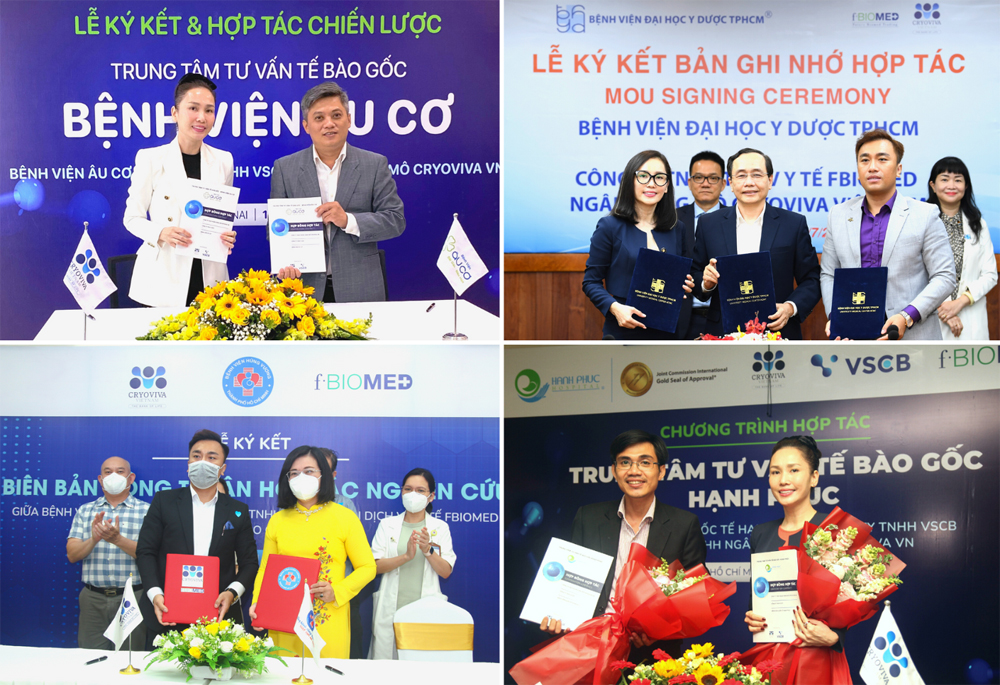
FSCB-Cryoviva has a global medical network, connecting leading hospitals both domestically and internationally

Internationally:
_Partnered with the Top 5 hospitals in Singapore:
1)Singapore General Hospital (SGH):The largest public hospital in Singapore, renowned for cancer treatment, cardiovascular and neurosurgery, and organ transplantation.
2) National University Hospital (NUH): A hospital strong in pediatrics, obstetrics, gastroenterology, and liver transplantation. Affiliated with the National University of Singapore, leading in clinical research.
3) Mount Elizabeth Hospital (Orchard): A leading private hospital, renowned in oncology, cardiology, and neurology. Provides services for international patients with multilingual support.
4) Tan Tock Seng Hospital (TTSH): Specializes in infectious diseases, stroke, geriatrics, and rehabilitation. Home to Singapore’s National Centre for Infectious Diseases.
5) Gleneagles Hospital: A high-end private hospital specializing in gastrointestinal–hepatobiliary surgery, cancer treatment, and reproductive support (IVF). Offers personalized services and fast-track treatment processes.
*Free consultation with Dr. Toh Keng Kiat – Medical Director of Cryoviva, with over 50 years of experience in Hematology and Internal Medicine. Networked with leading hospitals in Vietnam and internationally.
Domestically:
In Vietnam, Cryoviva collaborates on clinical research and applies stem cells for disease treatment with leading hospitals such as E Hospital, University Medical Center, Hung Vuong Hospital, Thong Nhat Hospital, and others.